
Civic Communism?
On Togliatti and Ordine Nuovo

One day, someone will ask me to write about the Ordine Nuovo group in Turin in 1919-1920. I’ve returned regularly to that group and its place in Italy’s convulsive post-World War I moment – referred to as the biennio rosso (‘two red years’) – when writing about interwar Italian thinkers.
L’Ordine Nuovo – ‘New Order’ – was the name of the weekly review founded by Antonio Gramsci, Palmiro Togliatti, Angelo Tasca, and Umberto Terracini, all former students of the University of Turin and, by 1919, all socialist activists in their late twenties. The ordinovisti, as they were collectively labelled, promoted the factory council movement, an initiative by Turin industrial workers (notably, the metal workers) to run the factories themselves – occupying them in advance of lockouts – rather than just going on strike. The occupations exploded into life during the unprecedented industrial unrest following the devastations of World War I. Although it was eventually weakened by the trade unions and the socialist party, and subsequently crushed by the Fascists, the movement inspired a view of socialism as the creation of independent civic communities based within the factories. It was part of the postwar European experiment in workers’ councils and participatory democracy that, for a brief moment, offered institutional alternatives to stumbling parliamentary liberalism. Ordine Nuovo was an innovative group that attracted all sorts of new ideas and personnel, particularly towards its leading figure, the Sardinian intellectual Antonio Gramsci. But each of its four founding editors were fascinating characters and went on, in various ways, to become significant figures in their own right.1
However, nobody has asked me to write about Ordine Nuovo! But I am researching the career and thought of Palmiro Togliatti, so I will briefly tell you something about him and his contribution to the Ordine Nuovo project. Togliatti is known largely as a shrewd yet pragmatic leader of the Italian Communist Party (PCI) after World War II. But the early phase of his career is vital for weaving some of the threads that made for the later, more complex figure and the distinctive party he led. In particular, I suggest, Ordine Nuovo initiated a commitment on his part to a unique, ‘civic’ model of communist politics.
Ordine Nuovo and the Factory Councils
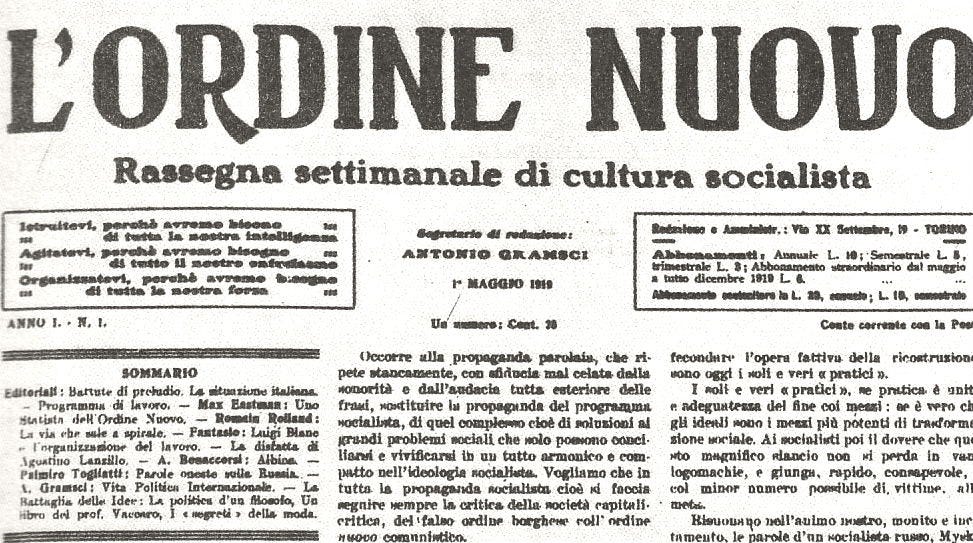
Photo: Front page of Ordine Nuovo. Photo (here and below) pinched from: https://www.edizionidelcapricorno.it/chirone/storia/lordine-nuovo/
By all accounts Togliatti was a studious type as a young man; less the polemical, creative thinker that Gramsci was and more the scholar, interested in technical details. Unlike Gramsci, a student of languages, Togliatti completed his degree (in law). But he was still very much a ‘humanist’ intellectual fascinated by topics of history and culture. If Gramsci was from the start a biting social critic, Togliatti’s early publications were often sarcastic and insistent on the authority of historical evidence over verbal exuberance.2 That deference to evidence mirrored the wider culture of Turin University in which they were both trained, where scientific ‘positivism’ was in vogue and intellectuals (particularly in the Law College) were often publicly engaged. They both eschewed positivism (and especially the crude Marxian socialism that was then popular in Italy) but it was still influential as a merciless demand for rigour.
Togliatti followed his friend Gramsci’s incisive critique of Italian political history as the failure to generate a popular state founded on an inclusive, national project of liberation. Gramsci had personally experienced that failure as a Southerner wary of the limited reach of the liberal state in the undeveloped Mezzogiorno. Togliatti, too, had partly grown up in Sardinia, although he was born in Genoa. Both won scholarships in 1911 to study in Turin, a vibrant industrial city populated by both factory workers and university academics. They approached socialism as a programme to re-found the state and to ‘reinvent’ Italians as modern citizens of a ‘mass’ society, not as a politics limited to sectional, trade union struggles seeking expanded rights or democratic concessions. After the Bolshevik revolution and in the face of postwar turbulence – prolonged strikes and protests across the country as parliamentary politics collapsed and politicians struggled to patch together a consensus – they openly identified themselves as ‘communists’. On founding L’Ordine Nuovo in May 1919, they soon directed its content to the factory occupations across the city.
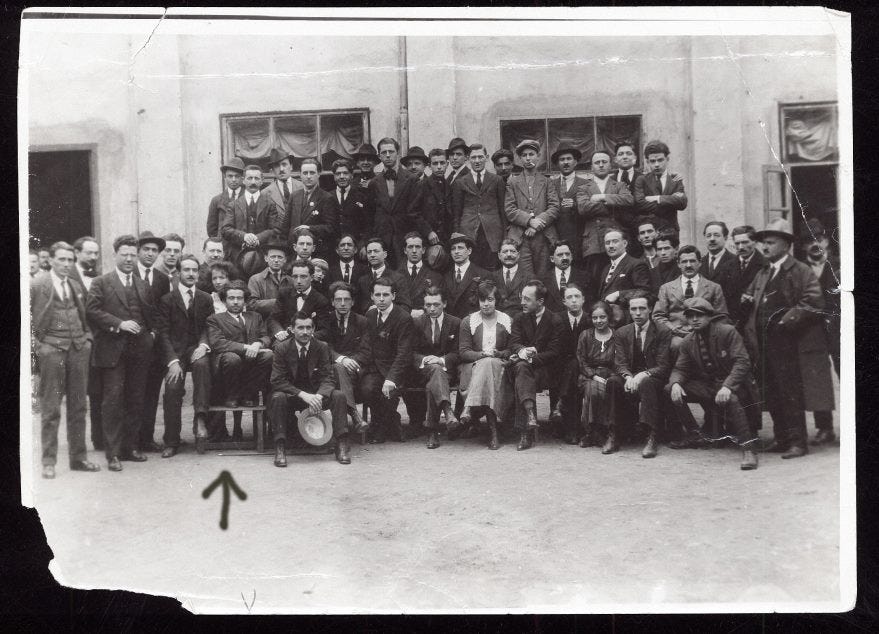
Photo: Gramsci (indicated by pointer) and the wider editorial group of Ordine Nuovo
Gramsci’s contributions to Ordine Nuovo set the editorial line for the group. He viewed the so-called ‘factory councils’ (consigli di fabbrica) as the basis for a new form of state centred on workers in the industrial workshops. The councils were built on former grievance committees (or ‘internal commissions’) established some years earlier to deal with issues and conflicts arising inside the factory workshops. Now, however, they were being used by the occupiers to run production independently of the managers. This initiative lent them a libertarian, anti-statist character that stood out from traditional socialist politics. It also reflected an independent attitude distinctive to Turin’s working classes. In asserting their ability to run production, they sought a collective strength beyond mere ‘bargaining power’. Differently from trade unions, which dealt with distinct trades and undertook negotiation with management outside the factory, the councils coordinated work inside the factories with the workers themselves. They did not distinguish between skilled/unskilled or unionised/non-unionised workers. Rather, they treated the factory as an integral space in which all workers had a part to play in the self-management of production.
For Gramsci, that all signalled a new type of egalitarian, participatory association, one that surpassed the liberal separation of ‘public’ and ‘private’. The labour process was no longer a purely private matter – workers were united by a common identity as ‘producers’, not simply contracted employees isolated from each other. As components of the production process, their specific roles and collective capacities overlapped to generate a new kind of public based on the idea of the ‘producer’. Here, thought Gramsci, was a substitute for ‘bourgeois’ parliamentary liberalism, where the citizens were isolated from each other and represented as members of a ‘community’ only in the abstract (and by others in a separate debating chamber). Under liberal government, shared responsibilities were imposed (by laws that supported private property and the right of the industrialists to command labour) and were therefore experienced as external constraints on personal freedom. But in the factory, Gramsci argued, individual ‘liberty’ and collective ‘discipline’ were bound together ‘organically’ in a spontaneous system driven by a common purpose (expressed as a ‘communist psychology’). If properly developed, the factory council, Gramsci went on, could set the priorities and coordinate the different tasks for each workshop. When joined together, they might form an inclusive, nation-wide system of planned and self-regulating productive communities.3
A Modernist Politics
Ordine Nuovo became the focal point for theoretical discussions in Turin about this project. It published articles by various writers outside mainstream socialist and trade union politics, and it debated – undogmatically – the relationship of the factory councils to the broader syndicalist and anarchist traditions from which it drew inspiration. Intellectuals, especially, were drawn to its novel grafting of practical issues of industrial processes and worker militancy onto expansive cultural and political horizons. The idea of supplanting the despised liberal elites with a new ruling class drawn from the organised working class was inspirational. It spoke to a long-standing disappointment among educated Italians at the narrow-minded and supine weakness of Italy’s bourgeoisie. For example, the young, self-styled ‘revolutionary liberal’, Piero Gobetti (also a student in law at Turin University), published theatre criticism in the journal and, later, hoped to produce a book collection of Gramsci’s writings on the factory councils.
Ordine Nuovo might be seen an instance of what Roger Griffin has called ‘political modernism’ – those avant guarde projects of the early 20th century of cultural, spiritual, and political regeneration that broke with traditional, bourgeois models of modernity (traditionally understood as gradual, linear ‘progress’). Likewise, Ordine Nuovo identified in the conflicts and disorder of the moment a transition to a new sense of time and space that broke with the hierarchies and distinctions of the nineteenth century and offered up the prospect of wholesale cultural renewal.4 Gramsci and Togliatti, writing together in June 1919, presented the internal commissions as ‘organs of worker's’ democracy’ (not just of power) ready to be ‘infused with new life and energy’.5
So what was Togliatti’s contribution to this project? As part of the founding team, he took part in the editorial gatherings where a common stance was agreed. Togliatti initially had responsibility for a regular column called the ‘Battle of Ideas’, where he reviewed recent publications such as books and articles in other journals. There he brought his critical – and still sarcastic – eye to the effervescence of radical ideas that flooded postwar public culture (he even had a swipe at Gobetti, who had his own cultural review - Energie Nove or ‘new energies’). Like Gramsci, Togliatti saw the factory councils as a powerful, practical demonstration of spontaneous, popular self-organisation, not the usual verbal posturing that characterised much of Italian intellectual life. ‘Praxis’ was very much in vogue as an idea at this time; workers were putting their ideas into practice, not indulging arbitrary abstractions.
As well as co-writing with Gramsci, Togliatti contributed a variety of articles of his own on the general significance of the councils. There he conjoined a taste for political modernism (a fascination for the new emerging from within, and substituting, the old) with an older language reminiscent of civic republicanism. In the postwar world, he argued, liberalism had lost its former ‘equilibrium’, it was in ‘decomposition’: neither the parliamentary state nor the free market economy could hide their intrinsic class partiality.6 Liberal politicians and industrialists relied ever more on the coercive state to crack down on the workers’ desire for freedom from arbitrary interference.
In this struggle between ‘life’ ‘and ‘death’, socialism, Togliatti argued, had to cease being merely a negative critique of capitalism and, instead, ‘become the affirmer and re-creator of the world’.7 That meant educating workers for self-government, preparing them for the conquest of power in new state institutions distinct from those of the bourgeoisie. Revolution was not, as radical socialists often implied, simply ‘insurrection’. Rather, in the factory council, it consisted in liberating the very ‘action of the worker in his place of work’.8 A new ‘sovereign’ order – a new sense of state and locus of authority – was emerging around the principle of freedom rooted in everyday practices of labour.
What we find in Togliatti’s defence of the factory councils is an attention to the political theoretical framing of the movement. Contrasting concepts such as freedom (libertà) and servitude (schiavitú) – core to civic republican thinking – are used to characterise the stakes of the experiment, suggesting that self-management of the workplace is equivalent to the integrity of a free people instituting its own political community. The liberal state and capital are positioned as parasitical threats to the organic expression of civic consciousness. But these ideas are also mixed with classic revolutionary (or Leninist) slogans about the ‘conquest of power’ and the necessity of ‘class dictatorship’, which suggest not so much the spontaneous vitality of a growing organism but the instrumental control of power, defended against a hostile enemy.9 On the one hand, the councils signalled a state emanating freely from the authentic consciousness of the workers; on the other hand, there was a divisive struggle for power and the question of how to win it.
This duality is perhaps not surprising since the Ordine Nuovo project was conducted at the same time as internal struggles and divisions between workers and the state, and within the Italian left, threatened the factory councils and even divided the ordinovisti. Strikes and occupations in Turin in April 1920 and then in September showed the factory councils to be unable to garner wider support outside Turin, and across the trade unions and the Socialist Party. The occupations were eventually negotiated to an end by way of compromise with industrialists and the government. Gramsci and Tasca also argued between themselves about the continued importance of older workers’ institutions like the trade unions. The ordinovisti agreed, however, that the councils could not themselves be the sole medium of revolution; for that, a new communist party, committed to securing the broader social and political conditions for worker’s state institutions, was required. Togliatti’s different emphases mirror the evolving – and clashing – priorities of the moment.
The factory council movement in Turin soon passed away, like the other experiments in revolution across Europe. Both Gramsci and Togliatti could see early on that it wasn’t going to last without wider political support. A Communist Party was founded in January 1921, but along rigidly sectarian lines quite at odds with Ordine Nuovo’s formerly inclusive and participatory approach to politics. Ordine Nuovo was turned into a party paper and ceased to be an experimental review. In 1922, Mussolini ‘seized’ power and within a few years all political opposition was banned. Gramsci eventually became leader of the communists but he was arrested by the regime in 1926 and spent the rest of his life in captivity. Togliatti took over the leadership and remained in exile for nearly twenty years.
The ‘Via Italiana’
But the idea of a civic communism was not abandoned altogether. After World War II and the communist party’s crucial role in the resistance and in rebuilding Italian democracy, Togliatti led a renewed party that was still committed to a creative and broad-based civic project, of sorts. This time, it was a project inside a multiparty system based on democratic procedures; what was later labelled the ‘Italian road to socialism’ (via Italiana al socialism).
Togliatti’s ‘New Party’ (partito nuovo) of 1944 emerged from the antifascist resistance as a mass organisation, not of insurrection but of radical societal reconstruction, committed to defending constitutional democracy and expanding freedoms. This wasn’t the factory-based project of earlier years but a party-led enterprise to put down cultural and political roots across society to promote a popular, democratic socialism. If its architecture was different, the principle of establishing civic presence endured, now recast as a more complex quest to achieve ‘hegemony’ (egemonia) (and not ‘sovereignty’) across society generally, in an anti-fascist (not anti-state) alliance of peasants and middle classes (especially intellectuals), as well as workers. The party aimed to mediate a diverse, pluralistic civil society, not fold it together into a single institution.
Nevertheless, Togliatti underscored the importance of the Turin ordinovisti – and Gramsci in particular – in initiating the notion of communism as a generative, civic project aimed at coordinating collective aspirations for freedom (thereby distinguishing it from Soviet socialism). In the late 1940s he translated into Italian and wrote a preface to Voltaire’s Treatise on Tolerance.10 He even debated the idea of freedom with the liberal political philosopher (another Turin intellectual), Norberto Bobbio, in the 1950s. Bobbio took him to task for failing to reconcile a ‘positive’ idea of enhanced civic freedom that Togliatti associated with socialism with the ‘negative’ freedom required to protect people from their own institutions. That tension, which Bobbio later argued ran through the whole Marxist tradition, could not escape a instrumentalist notion of power as something ‘occupied’ and possessed by a single class (or, indeed, by its party representative).11
Undoubtedly there are many contradictions to explore, both in Togliatti’s leadership of the PCI (not least the influence of Stalinism) and in his conception of the relation of individual liberty to collective ownership, economic planning, and civil liberties. But, still, there’s an important line of continuity there with his earlier civic communism, one that is a defining thread in the later trajectory of his party. Communism is now certainly defunct as a programmatic ideal. Yet the ordinovisti’s expansive conception of politics as a civic practice that engages with people in their own struggles for collective freedoms continues to be a vital, if formidable, task for the left.
Gramsci (1891-1937) became leader of the Italian Communist Party (PCI) but was imprisoned in 1926 by the Fascist regime. His ‘Prison Notebooks’ have since made him a famous Marxist thinker. Togliatti (1893-1964) became PCI leader following Gramsci’s arrest and, after the collapse of Fascism, adapted the PCI to postwar democracy. Tasca (1892-1960) was thrown out of the PCI in the late ‘20s after criticising Stalin. He associated with independent socialists and aligned himself with the Vichy regime. Terracini (1895-1983) spent 11 years in Fascist prisons before being freed by partisans. He represented the PCI in the postwar Constituent Assembly and became a Senator for the party.
Togliatti took up journalism only in 1917, after serving as a medical orderly in the army - poor eyesight stopped him fighting on the front. Gramsci was writing for the socialist press since c. 1914 and went full time in 1915.
A selection of Gramsci’s writings on the factory councils can be found in Gramsci, Selections from Political Writings (1910-1920), ed. Q. Hoare (Lawrence & Wishart, 1977), esp. pp. 63 ff.
See Roger Griffin, Modernism and Fascism (Palgrave, 2007). Of course, for Griffin, political modernism is the intellectual-cultural foundation for fascism, which took spiritual regeneration in a radically authoritarian direction.
‘Workers Democracy’, Selections from Political Writings, 66.
See Togliatti, ‘Controllo di classe’, Opere, vol. 1, ed. E. Ragionieri (Editori Riuniti, 1967) (hereafter Opere1, 135-39; 'Psicologia socialista', Opere1, 111-13; 'Lo stato capitalistico e lo sciopero', Opere1, 100-102.
'Creare una scuola', Opere1, 127
'La constituzione dei Soviet in Italia', Opere1, 146-47
See ‘Guerra di classe’ and ‘Al potere’, Opere1, 160-63 and 169-73.
Voltaire, Trattato sulla toleranza, ed. P. Togliatti (Universale Economico, 1949).
See Norberto Bobbio & Palmiro Togliatti, Sulla libertà, ed. Michele Ciliberto (Edizioni della Normale, 2025); and Bobbio, Which Socialism? Marxism, Socialism, and Democracy (Polity, 1988).